Partner Profile:
Doug Salway, Sage Automotive Interiors
February 23, 2026
February 23, 2026
You might not guess it from his unassuming demeanor, but Doug Salway has built a career that has left a lasting mark on the automotive industry, the CU-ICAR campus and his own family.
After graduating from North Carolina State University with a degree in textile design, Doug began his career designing fabrics for men’s and women’s apparel. Eight years later, in 1996, he relocated to South Carolina to join the automotive division of Milliken & Company, now Sage Automotive Interiors.
As a fabric designer, Doug takes immense pride in the intricate details of his craft. Developing materials for automotive interiors is often a three-year process — one that can easily go unnoticed by the average driver. Yet a few minutes in Doug’s office reveals the artistry and precision woven into every pattern. His meticulous approach has led to collaborations with global automakers, three technological patents and even the opportunity to purchase a vehicle featuring fabric of his own design.
In 2011, Sage Automotive Interiors moved its corporate headquarters to the Clemson University International Center for Automotive Research (CU-ICAR) in Greenville, South Carolina. Fifteen years later, Doug still appreciates the campus’s Class A office space, amenities and community atmosphere. He also enjoys welcoming the company’s global design teams to Greenville for their biennial meetings.
Perhaps the most unexpected benefit of working on the CU-ICAR campus has been his involvement with students in Clemson’s Deep Orange program.
Deep Orange is a framework within the Clemson University Department of Automotive Engineering that immerses graduate students in the role of an OEM or supplier, challenging them to design and build a fully functional prototype vehicle in just 18 months. Along the way, students conduct research, develop customer personas and gain hands-on experience in every facet of vehicle development — including interior design and fabrication. That’s where Doug steps in.
“The students are incredibly strong on the mechanical side,” Doug said, “but they’re often less experienced with the aesthetic elements. We help guide them through colors, fabrics, trims and those types of decisions.”
Doug has contributed to multiple Deep Orange projects, including Deep Orange 10, an autonomous ride-share vehicle developed in partnership with Ford. He worked with students to create a custom seat pattern — one he notes is now being echoed across the industry — and helped develop a specialized flooring material designed to withstand heavy use while providing traction for wheelchair accessibility.
The collaboration is far from one-sided.
“I’m always inspired by how forward-thinking the students are, especially at such a young age,” Doug said. “They move from ideas to cardboard models to fully functioning autonomous vehicles in a short amount of time. It’s amazing to watch.”
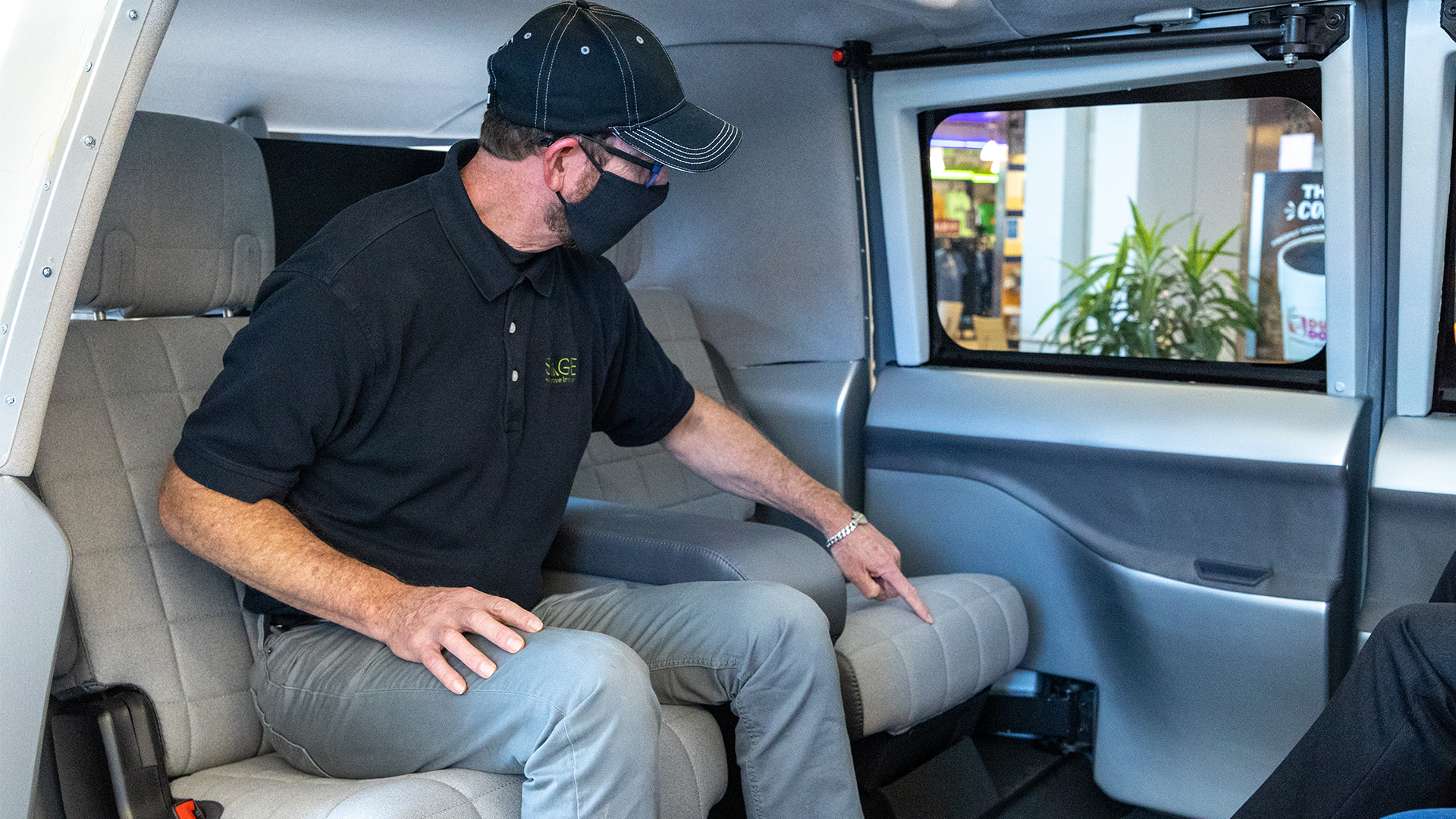
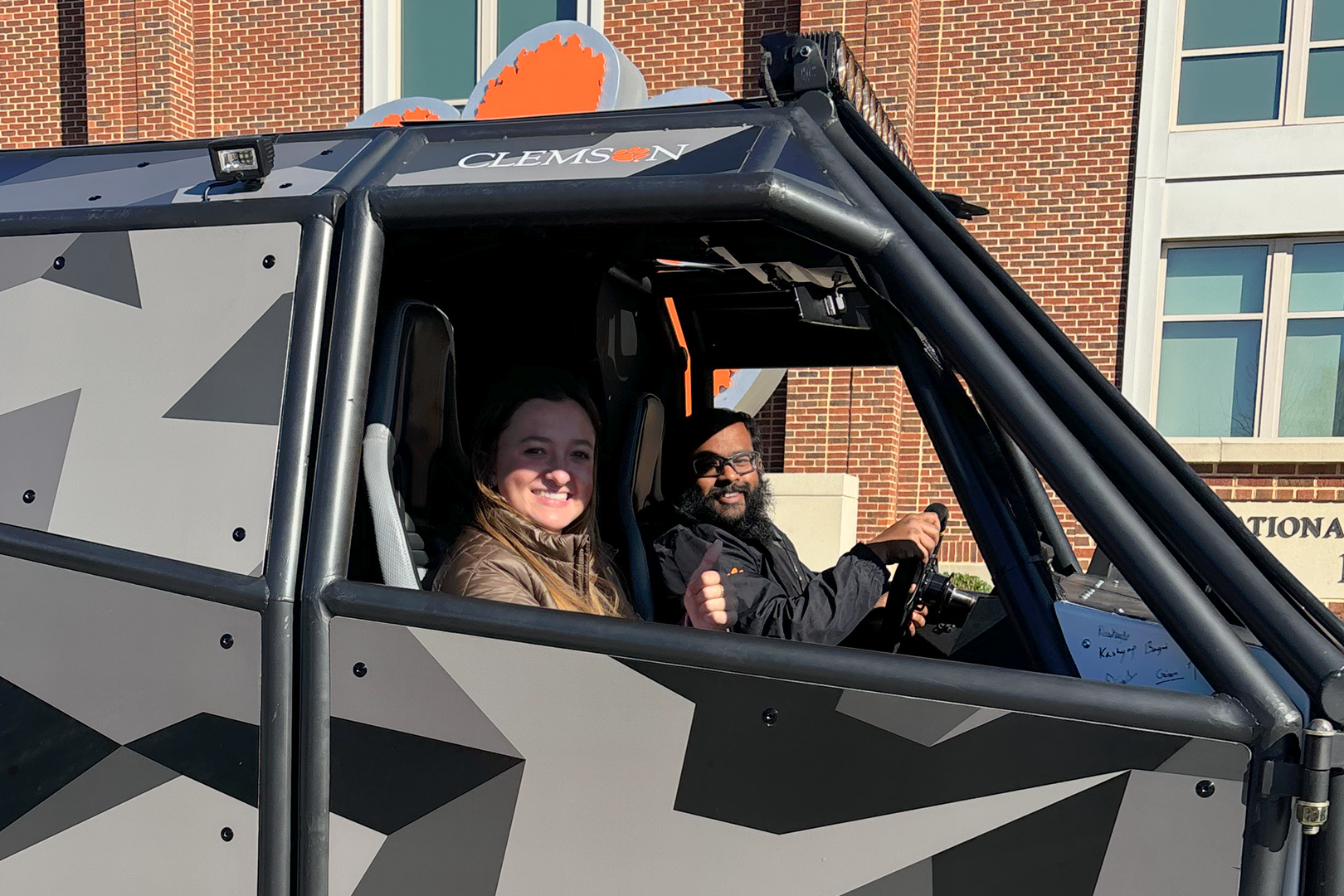
Doug examining the interior of Deep Orange 10 at the official unveiling in 2020.
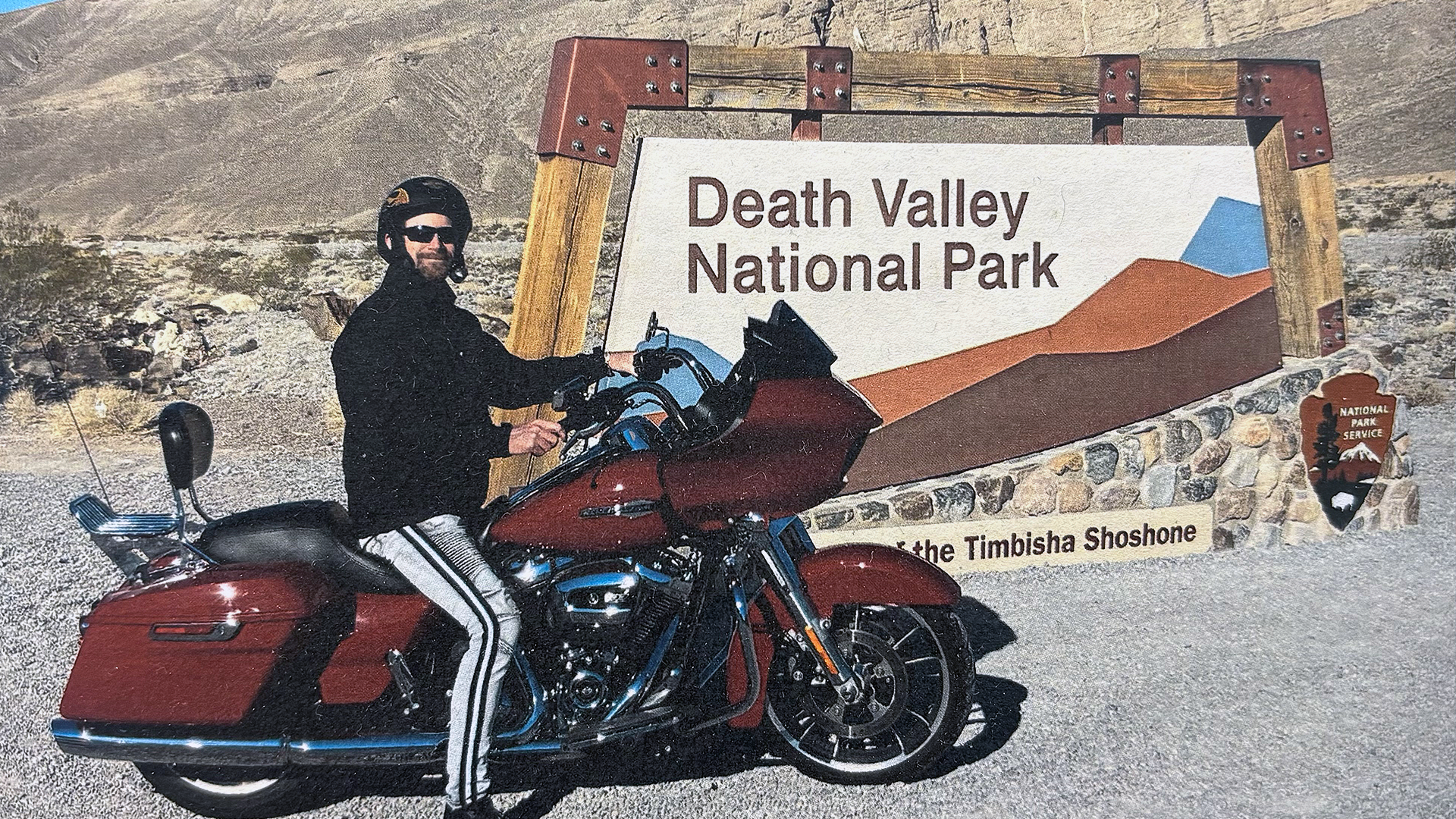
Doug’s curiosity and appreciation for detail extend well beyond the workplace. At home, he enjoys spending time with his family and has recently taken up bowling, discovering that beneath its simple exterior lies a game of precision and nuance — much like the intricate work that has shaped his career. Doug welcomes the opportunity to travel, which he does at least biennially when gathering with design colleagues from across the globe. When possible, he also continues to enjoy riding motorcycles, a longtime hobby that has taken him through Maui, Death Valley, the Mojave Desert and along California’s iconic Pacific Coast Highway.



This year marks 30 years with Sage Automotive Interiors and 35 years of marriage to his wife, Ann. But among his proudest milestones is one that began nearly four decades ago. When Doug graduated in 1988, he became the first person in his family to earn a college degree. Today, he and Ann are the proud parents of two college graduates: one who followed her mother’s career path as a teacher, and another who plans to return to school to pursue a career as a dietitian, furthering the family’s shared commitment to education and lifelong learning.
Whether he’s shaping trends within the automotive industry, mentoring the next generation of engineers or encouraging education within his own family, Doug continues to weave together a legacy defined by craftsmanship, curiosity and a commitment to the next generation.
You might not guess it from his unassuming demeanor, but Doug Salway has built a career that has left a lasting mark on the automotive industry, the CU-ICAR campus and his own family.
After graduating from North Carolina State University with a degree in textile design, Doug began his career designing fabrics for men’s and women’s apparel. Eight years later, in 1996, he relocated to South Carolina to join the automotive division of Milliken & Company, now Sage Automotive Interiors.
As a fabric designer, Doug takes immense pride in the intricate details of his craft. Developing materials for automotive interiors is often a three-year process — one that can easily go unnoticed by the average driver. Yet a few minutes in Doug’s office reveals the artistry and precision woven into every pattern. His meticulous approach has led to collaborations with global automakers, three technological patents and even the opportunity to purchase a vehicle featuring fabric of his own design.
In 2011, Sage Automotive Interiors moved its corporate headquarters to the Clemson University International Center for Automotive Research (CU-ICAR) in Greenville, South Carolina. Fifteen years later, Doug still appreciates the campus’s Class A office space, amenities and community atmosphere. He also enjoys welcoming the company’s global design teams to Greenville for their biennial meetings.
Perhaps the most unexpected benefit of working on the CU-ICAR campus has been his involvement with students in Clemson’s Deep Orange program.
Deep Orange is a framework within the Clemson University Department of Automotive Engineering that immerses graduate students in the role of an OEM or supplier, challenging them to design and build a fully functional prototype vehicle in just 18 months. Along the way, students conduct research, develop customer personas and gain hands-on experience in every facet of vehicle development — including interior design and fabrication. That’s where Doug steps in.
“The students are incredibly strong on the mechanical side,” Doug said, “but they’re often less experienced with the aesthetic elements. We help guide them through colors, fabrics, trims and those types of decisions.”
Doug has contributed to multiple Deep Orange projects, including Deep Orange 10, an autonomous ride-share vehicle developed in partnership with Ford. He worked with students to create a custom seat pattern — one he notes is now being echoed across the industry — and helped develop a specialized flooring material designed to withstand heavy use while providing traction for wheelchair accessibility.
The collaboration is far from one-sided.
“I’m always inspired by how forward-thinking the students are, especially at such a young age,” Doug said. “They move from ideas to cardboard models to fully functioning autonomous vehicles in a short amount of time. It’s amazing to watch.”

Doug examining the interior of Deep Orange 10 at the official unveiling in 2020.
Doug’s curiosity and appreciation for detail extend well beyond the workplace. At home, he enjoys spending time with his family and has recently taken up bowling, discovering that beneath its simple exterior lies a game of precision and nuance — much like the intricate work that has shaped his career. Doug welcomes the opportunity to travel, which he does at least biennially when gathering with design colleagues from across the globe. When possible, he also continues to enjoy riding motorcycles, a longtime hobby that has taken him through Maui, Death Valley, the Mojave Desert and along California’s iconic Pacific Coast Highway.


This year marks 30 years with Sage Automotive Interiors and 35 years of marriage to his wife, Ann. But among his proudest milestones is one that began nearly four decades ago. When Doug graduated in 1988, he became the first person in his family to earn a college degree. Today, he and Ann are the proud parents of two college graduates: one who followed her mother’s career path as a teacher, and another who plans to return to school to pursue a career as a dietitian, furthering the family’s shared commitment to education and lifelong learning.
Whether he’s shaping trends within the automotive industry, mentoring the next generation of engineers or encouraging education within his own family, Doug continues to weave together a legacy defined by craftsmanship, curiosity and a commitment to the next generation.
You might not guess it from his unassuming demeanor, but Doug Salway has built a career that has left a lasting mark on the automotive industry, the CU-ICAR campus and his own family.
After graduating from North Carolina State University with a degree in textile design, Doug began his career designing fabrics for men’s and women’s apparel. Eight years later, in 1996, he relocated to South Carolina to join the automotive division of Milliken & Company, now Sage Automotive Interiors.
As a fabric designer, Doug takes immense pride in the intricate details of his craft. Developing materials for automotive interiors is often a three-year process — one that can easily go unnoticed by the average driver. Yet a few minutes in Doug’s office reveals the artistry and precision woven into every pattern. His meticulous approach has led to collaborations with global automakers, three technological patents and even the opportunity to purchase a vehicle featuring fabric of his own design.
In 2011, Sage Automotive Interiors moved its corporate headquarters to the Clemson University International Center for Automotive Research (CU-ICAR) in Greenville, South Carolina. Fifteen years later, Doug still appreciates the campus’s Class A office space, amenities and community atmosphere. He also enjoys welcoming the company’s global design teams to Greenville for their biennial meetings.
Perhaps the most unexpected benefit of working on the CU-ICAR campus has been his involvement with students in Clemson’s Deep Orange program.
Deep Orange is a framework within the Clemson University Department of Automotive Engineering that immerses graduate students in the role of an OEM or supplier, challenging them to design and build a fully functional prototype vehicle in just 18 months. Along the way, students conduct research, develop customer personas and gain hands-on experience in every facet of vehicle development — including interior design and fabrication. That’s where Doug steps in.
“The students are incredibly strong on the mechanical side,” Doug said, “but they’re often less experienced with the aesthetic elements. We help guide them through colors, fabrics, trims and those types of decisions.”
Doug has contributed to multiple Deep Orange projects, including Deep Orange 10, an autonomous ride-share vehicle developed in partnership with Ford. He worked with students to create a custom seat pattern — one he notes is now being echoed across the industry — and helped develop a specialized flooring material designed to withstand heavy use while providing traction for wheelchair accessibility.
The collaboration is far from one-sided.
“I’m always inspired by how forward-thinking the students are, especially at such a young age,” Doug said. “They move from ideas to cardboard models to fully functioning autonomous vehicles in a short amount of time. It’s amazing to watch.”

Doug examining the interior of Deep Orange 10 at the official unveiling in 2020.
Doug’s curiosity and appreciation for detail extend well beyond the workplace. At home, he enjoys spending time with his family and has recently taken up bowling, discovering that beneath its simple exterior lies a game of precision and nuance — much like the intricate work that has shaped his career. Doug welcomes the opportunity to travel, which he does at least biennially when gathering with design colleagues from across the globe. When possible, he also continues to enjoy riding motorcycles, a longtime hobby that has taken him through Maui, Death Valley, the Mojave Desert and along California’s iconic Pacific Coast Highway.


This year marks 30 years with Sage Automotive Interiors and 35 years of marriage to his wife, Ann. But among his proudest milestones is one that began nearly four decades ago. When Doug graduated in 1988, he became the first person in his family to earn a college degree. Today, he and Ann are the proud parents of two college graduates: one who followed her mother’s career path as a teacher, and another who plans to return to school to pursue a career as a dietitian, furthering the family’s shared commitment to education and lifelong learning.
Whether he’s shaping trends within the automotive industry, mentoring the next generation of engineers or encouraging education within his own family, Doug continues to weave together a legacy defined by craftsmanship, curiosity and a commitment to the next generation.
This content is password-protected. To view it, please enter the password below.
]]>
November 24, 2025
November 24, 2025
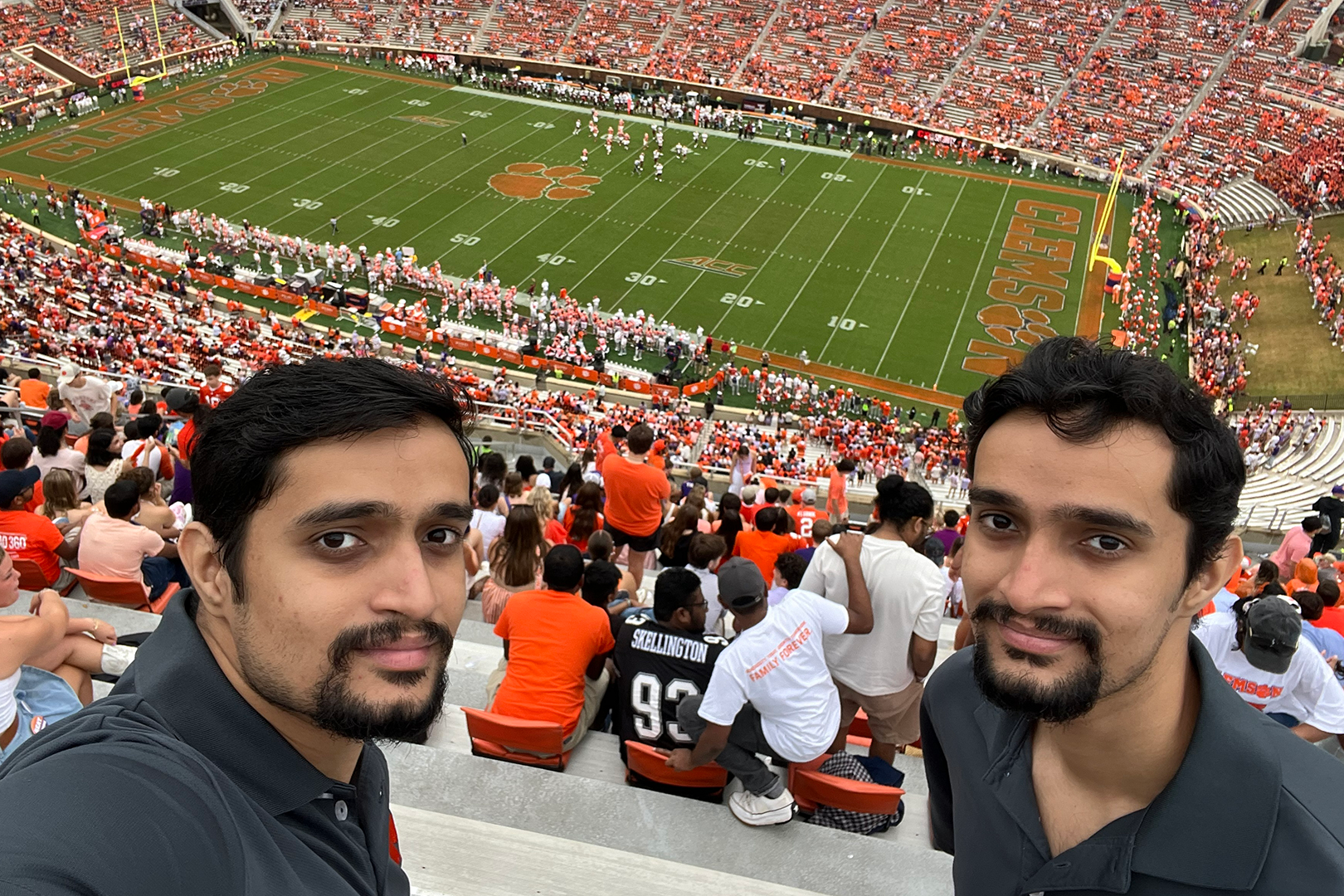
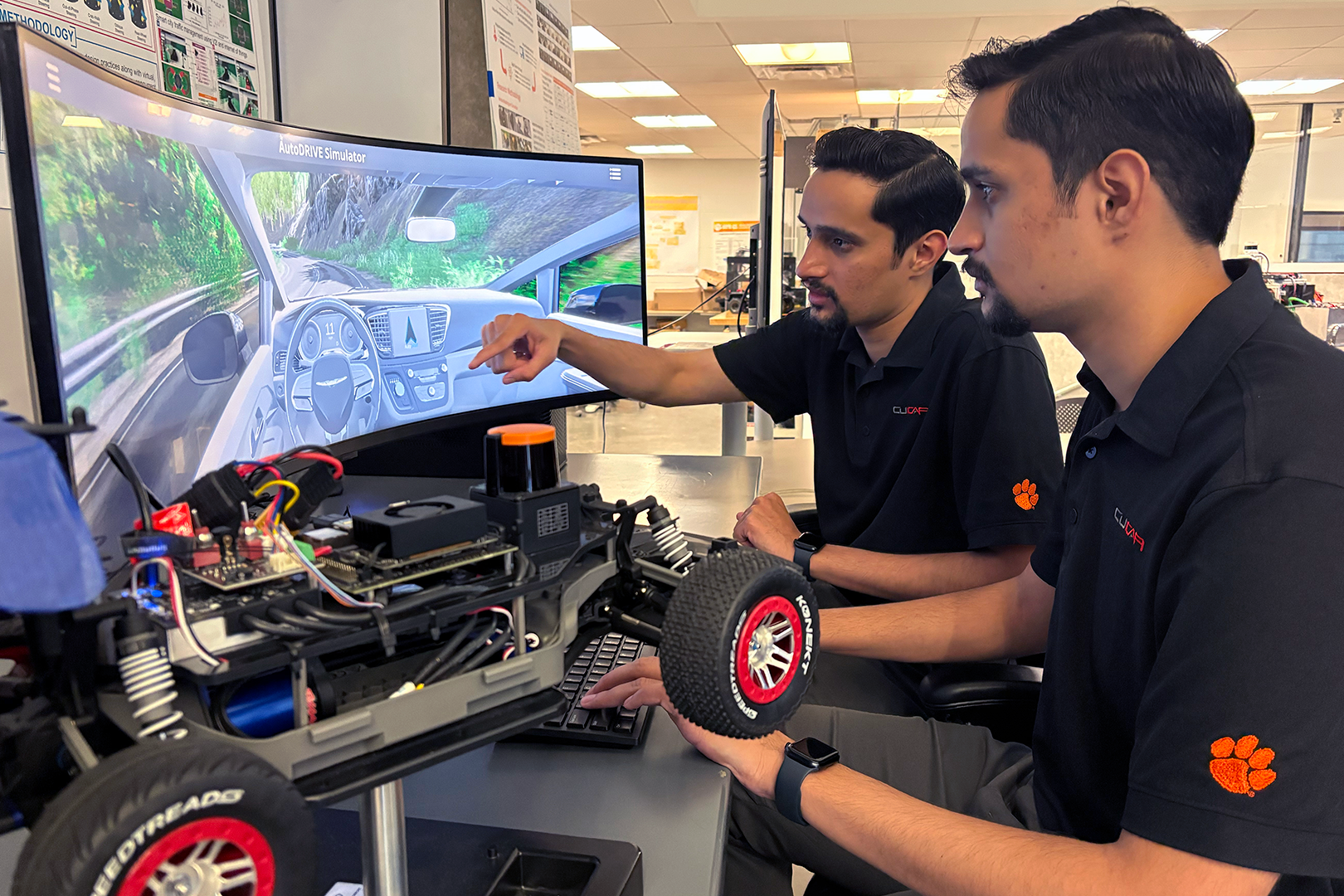
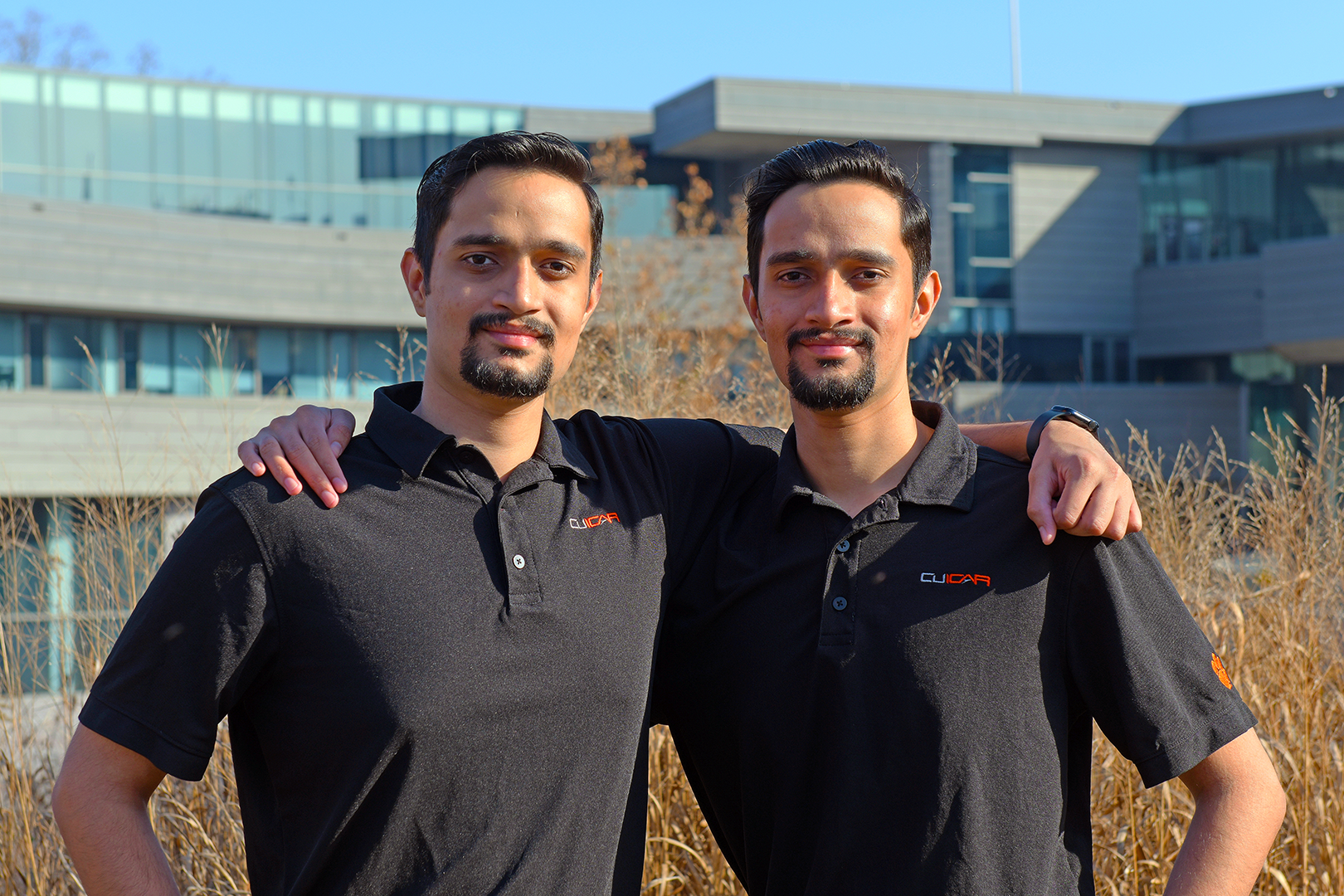
A digital twin uses real-world data to power a virtual counterpart—an idea reshaping modern engineering. For Chinmay and Tanmay Samak, mirrored counterparts is not only the focus of their research at the Clemson University International Center for Automotive Research (CU-ICAR), it’s also their daily experience as twins who are identical in virtually every way.
Natives of Pune, India, Chinmay and Tanmay have always known what they have in common truly makes them unique. “It’s always been fun to have a twin, especially one that resonates with you,” said Chinmay. “Twins generally get compared constantly so they choose a mechanism for growing apart or at least a way to differentiate themselves, but that hasn’t been our experience.”
From favorite foods to hobbies, and even their favorite color, the Samak twins have no answer for the common question of how to differentiate them. “We’ve been together since day one and hope to keep it that way,” said Tanmay with a smile.
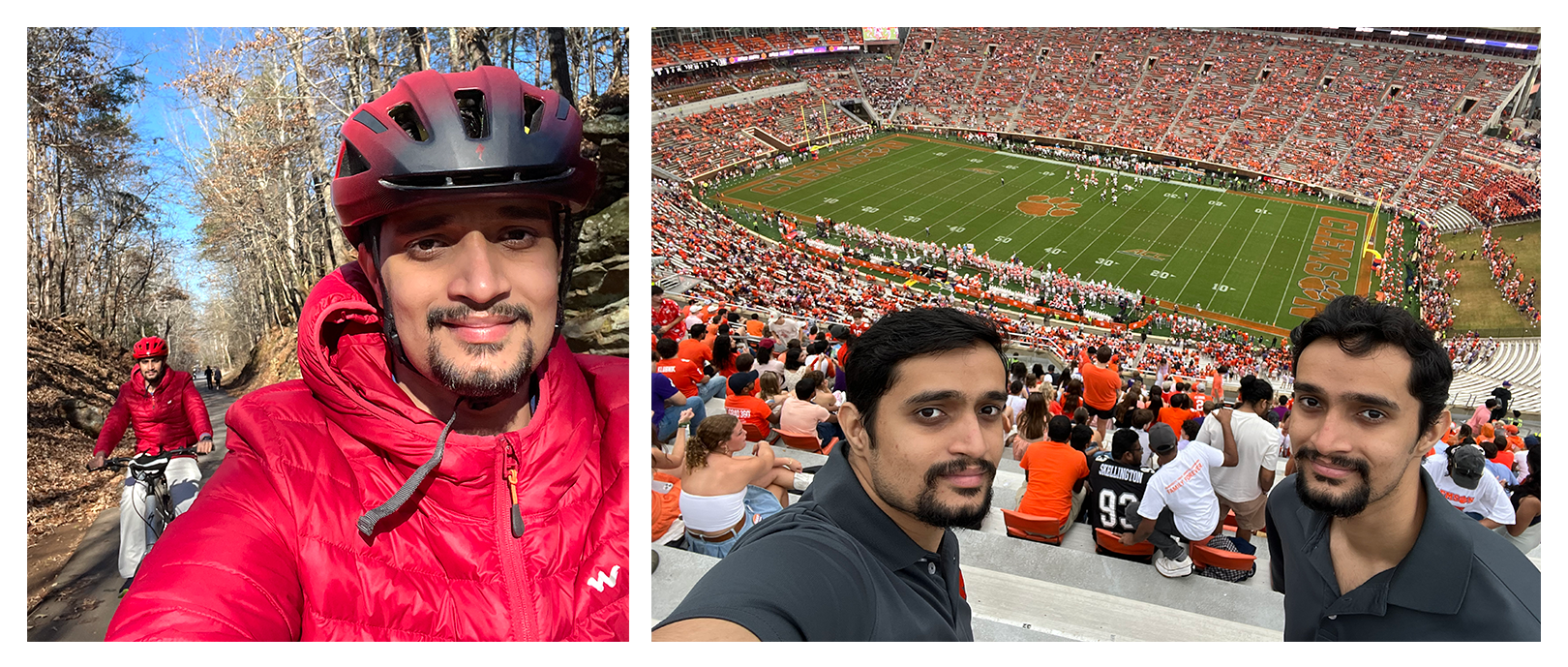
At a young age their shared interests included activities like cycling, hiking and tinkering in the field of robotics. What began in 8th grade as building line-following and obstacle-avoidance robots grew into research publications and consecutive first place finishes in NASA’s space settlement design competition. By the time they reached their undergraduate studies, they found another shared fascination: autonomous ground vehicles—a passion that would eventually bring them across the world to Greenville, South Carolina.
When considering graduate programs, the brothers developed their own unique criteria to complement university rankings and notoriety.
Despite having never visited, they chose Clemson University, and specifically the Automotive Engineering program located at CU-ICAR. Three and a half years later, they are nearing the completion of their PhDs, with both focused on advancing digital twin technology. Working in the Automation, Robotics and Mechatronics (ARM) Lab under Dr. Venkat Krovi, they are helping to close the loop between real-world vehicle behavior and high-precision simulation. Tanmay specializes in translating real-world data into accurate virtual models. Chinmay’s work mirrors this from the opposite direction, ensuring simulation results can be transferred reliably to physical vehicles.
Looking back on their decision, Chinmay shared what he’d tell their 2022 selves: “In a simple statement, what you are dreaming of is about to come true.”

Due to COVID-19, the twins arrived in Greenville knowing Dr. Krovi and CU-ICAR only through digital imagery, articles and virtual interviews. Their real-world experience far exceeded expectations.
Being welcomed with hands-on access to the Open Connected and Automated Vehicle (OpenCAV) during their first weeks on campus, months earlier than expected, made it clear they had found the mentor they hoped for. “Dr. Krovi is the ideal advisor, especially for us,” said Chinmay. “He’s provided the technical and academic direction for areas where he knows we need to learn and also given us the freedom to explore on our own and approach him when we need guidance.”
The positive surprises extended out of the lab as they began to explore the CU-ICAR campus and the surrounding Greenville community. “CU-ICAR has all the right people on campus,” noted Tanmay. “You have students, professors, and industry professionals, and they’re all headed towards the same objectives. No matter who you’re working with, you can’t go wrong.”
Off campus, Greenville quickly became their second home, one they describe as the perfect balance of modern and tranquil. They fell in love with the mild weather, vibrant downtown, access to nature, and as cyclists, the city’s 28-mile greenway known as the Swamp Rabbit Trail.

Within the next year, Chinmay and Tanmay will add “Clemson graduate” to their list of accomplishments. From there, they hope to stay connected to academia while also joining industry through startup ventures. They plan to continue growing their online presence as the Tinker Twins and expand AutoDRIVE, the digital twin ecosystem they created together.
While the exact path ahead is still unfolding, one thing remains certain:
“Whatever it is, most importantly, we’ll do it together.”

A digital twin uses real-world data to power a virtual counterpart—an idea reshaping modern engineering. For Chinmay and Tanmay Samak, mirrored counterparts is not only the focus of their research at the Clemson University International Center for Automotive Research (CU-ICAR), it’s also their daily experience as twins who are identical in virtually every way.
Natives of Pune, India, Chinmay and Tanmay have always known what they have in common truly makes them unique. “It’s always been fun to have a twin, especially one that resonates with you,” said Chinmay. “Twins generally get compared constantly so they choose a mechanism for growing apart or at least a way to differentiate themselves, but that hasn’t been the case for us.”
From favorite foods to hobbies, and even their favorite color, the Samak twins have no answer for the common question of how to differentiate them. “We’ve been together since day one and hope to keep it that way,” said Tanmay with a smile.
At a young age their shared interests included activities like swimming, cycling, hiking and tinkering in the field of robotics. What began in 8th grade as building line-following and obstacle-avoidance robots grew into research publications and consecutive first place finishes in NASA’s space settlement design competition. By the time they reached their undergraduate studies, they found another shared fascination: autonomous ground vehicles—a passion that would eventually bring them across the world to Greenville, South Carolina.
When considering graduate programs, the brothers developed their own unique criteria to complement university rankings and notoriety.
Despite having never visited, they chose Clemson University, and specifically the Automotive Engineering program located at CU-ICAR. Three and a half years later, they are nearing the completion of their PhDs, with both focused on advancing digital twin technology. Working in the Automation, Robotics and Mechatronics (ARM) Lab under Dr. Venkat Krovi, they are helping to close the loop between real-world vehicle behavior and high-precision simulation. Tanmay specializes in translating real-world data into accurate virtual models. Chinmay’s work mirrors this from the opposite direction, ensuring simulation results can be transferred reliably to physical vehicles.
Looking back on their decision, Chinmay shared what he’d tell their 2022 selves: “In a simple statement, what you are dreaming of is about to come true.”

Due to COVID-19, the twins arrived in Greenville knowing Dr. Krovi and CU-ICAR only through digital imagery, articles and virtual interviews. Their real-world experience far exceeded expectations.
Being welcomed with hands-on access to the Open Connected and Automated Vehicle (OpenCAV) during their first weeks on campus, months earlier than expected, made it clear they had found the mentor they hoped for. “Dr. Krovi is the ideal advisor, especially for us,” said Chinmay. “He’s provided the technical and academic direction for areas where he knows we need to learn and also given us the freedom to explore on our own and approach him when we need guidance.”
The positive surprises extended out of the lab as they began to explore the CU-ICAR campus and the surrounding Greenville community. “CU-ICAR has all the right people on campus,” noted Tanmay. “You have students, professors, and industry professionals, and they’re all headed towards the same objectives. No matter who you’re working with, you can’t go wrong.”
Off campus, Greenville quickly became their second home, one they describe as the perfect balance of modern and tranquil. They fell in love with the mild weather, vibrant downtown, access to nature, and as cyclists, the city’s 28-mile greenway known as the Swamp Rabbit Trail.

Within the next year, Chinmay and Tanmay will add “Clemson graduate” to their list of accomplishments. From there, they hope to stay connected to academia while also joining industry through startup ventures. They plan to continue growing their online presence as the Tinker Twins and expand AutoDRIVE, the digital twin ecosystem they created together.
While the exact path ahead is still unfolding, one thing remains certain:
“Whatever it is, most importantly, we’ll do it together.”

A digital twin uses real-world data to power a virtual counterpart—an idea reshaping modern engineering. For Chinmay and Tanmay Samak, mirrored counterparts is not only the focus of their research at the Clemson University International Center for Automotive Research (CU-ICAR), it’s also their daily experience as twins who are identical in virtually every way.
Natives of Pune, India, Chinmay and Tanmay have always known what they have in common truly makes them unique. “It’s always been fun to have a twin, especially one that resonates with you,” said Chinmay. “Twins generally get compared constantly so they choose a mechanism for growing apart or at least a way to differentiate themselves, but that hasn’t been the case for us.”
From favorite foods to hobbies, and even their favorite color, the Samak twins have no answer for the common question of how to differentiate them. “We’ve been together since day one and hope to keep it that way,” said Tanmay with a smile.
At a young age their shared interests included activities like swimming, cycling, hiking and tinkering in the field of robotics. What began in 8th grade as building line-following and obstacle-avoidance robots grew into research publications and consecutive first place finishes in NASA’s space settlement design competition. By the time they reached their undergraduate studies, they found another shared fascination: autonomous ground vehicles—a passion that would eventually bring them across the world to Greenville, South Carolina.
When considering graduate programs, the brothers developed their own unique criteria to complement university rankings and notoriety.
Despite having never visited, they chose Clemson University, and specifically the Automotive Engineering program located at CU-ICAR. Three and a half years later, they are nearing the completion of their PhDs, with both focused on advancing digital twin technology. Working in the Automation, Robotics and Mechatronics (ARM) Lab under Dr. Venkat Krovi, they are helping to close the loop between real-world vehicle behavior and high-precision simulation. Tanmay specializes in translating real-world data into accurate virtual models. Chinmay’s work mirrors this from the opposite direction, ensuring simulation results can be transferred reliably to physical vehicles.
Looking back on their decision, Chinmay shared what he’d tell their 2022 selves: “In a simple statement, what you are dreaming of is about to come true.”

Due to COVID-19, the twins arrived in Greenville knowing Dr. Krovi and CU-ICAR only through digital imagery, articles and virtual interviews. Their real-world experience far exceeded expectations.
Being welcomed with hands-on access to the Open Connected and Automated Vehicle (OpenCAV) during their first weeks on campus, months earlier than expected, made it clear they had found the mentor they hoped for. “Dr. Krovi is the ideal advisor, especially for us,” said Chinmay. “He’s provided the technical and academic direction for areas where he knows we need to learn and also given us the freedom to explore on our own and approach him when we need guidance.”
The positive surprises extended out of the lab as they began to explore the CU-ICAR campus and the surrounding Greenville community. “CU-ICAR has all the right people on campus,” noted Tanmay. “You have students, professors, and industry professionals, and they’re all headed towards the same objectives. No matter who you’re working with, you can’t go wrong.”
Off campus, Greenville quickly became their second home, one they describe as the perfect balance of modern and tranquil. They fell in love with the mild weather, vibrant downtown, access to nature, and as cyclists, the city’s 28-mile greenway known as the Swamp Rabbit Trail.

Within the next year, Chinmay and Tanmay will add “Clemson graduate” to their list of accomplishments. From there, they hope to stay connected to academia while also joining industry through startup ventures. They plan to continue growing their online presence as the Tinker Twins and expand AutoDRIVE, the digital twin ecosystem they created together.
While the exact path ahead is still unfolding, one thing remains certain:
“Whatever it is, most importantly, we’ll do it together.”

October 10, 2025
Partner Profile:
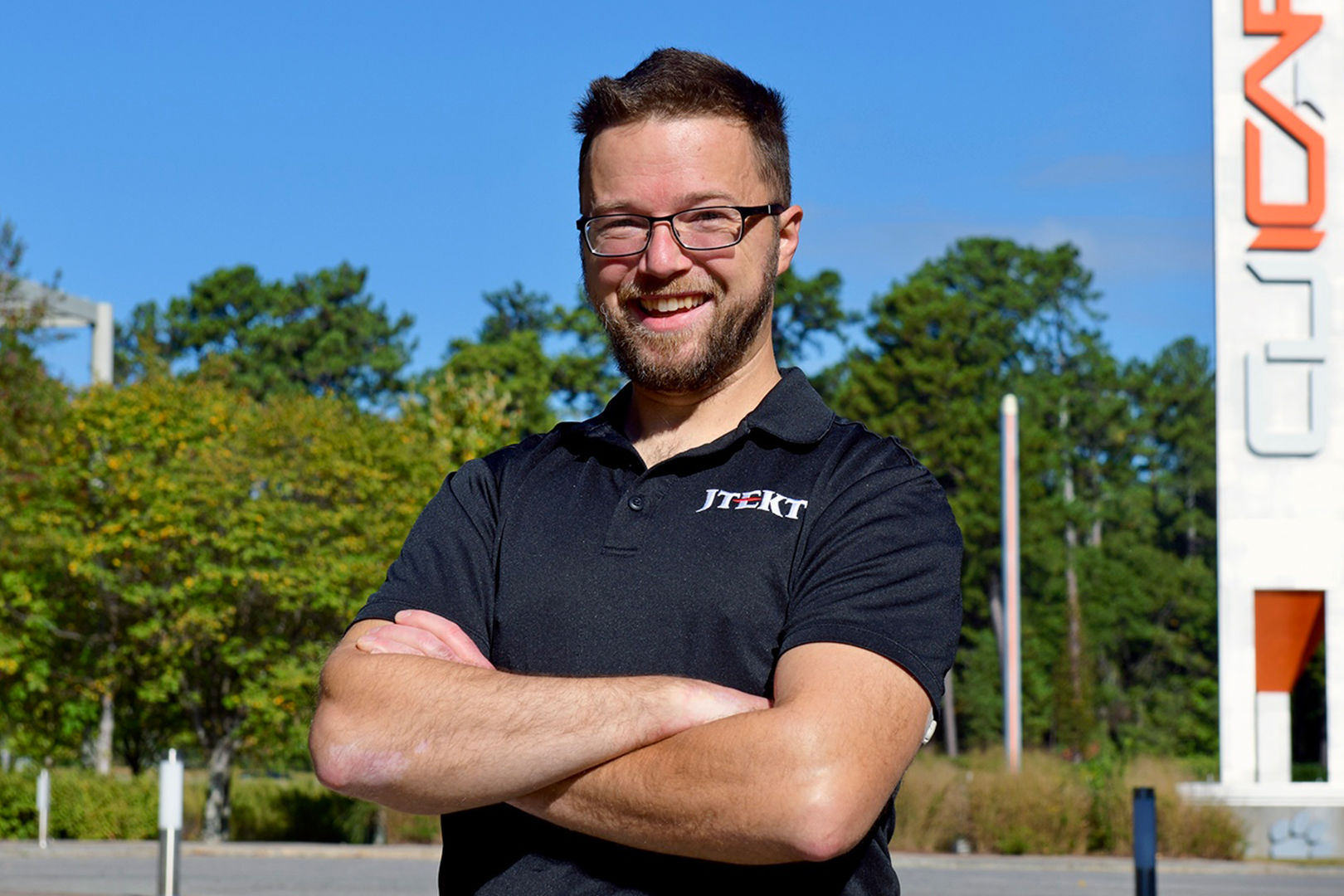
Max Frantz, JTEKT North America
October 10, 2025
What began as a personal decision to be closer to family has led Max Frantz to a career that continues to challenge and inspire him—while also allowing space for what matters most outside of work.
When Max and his wife made the decision to move from Philadelphia, their goal was simple: be closer to family and raise their children in a place with natural beauty and a strong sense of community. Greenville, South Carolina—tucked against the foothills of the Blue Ridge Mountains—offered just that.
Shortly after relocating, Max accepted a role as a Principal Product Development Engineer with JTEKT North America. The job proved to be a perfect fit. On the new product development team, Max works on the front end of innovation—identifying emerging needs and rapidly building proof-of-concept tests to determine what’s worth pursuing.
Eight years later, that work still excites him. Whether he’s brainstorming new solutions or rolling up his sleeves to build out an early prototype, Max continues to thrive in a role that keeps him engaged and thinking forward.
At home, he finds equal joy in his role as a dad. From family hikes at Paris Mountain State Park to weekends spent at kids’ sporting events, Max is all-in—professionally and personally.
Over time, Max began to feel a pull toward expanding his technical expertise. His interest in automated systems and advanced mechanical design kept growing, and he wanted to understand not just how things work—but why.
With encouragement and financial support from JTEKT, he enrolled in Clemson University’s Master’s program in Mechanical Engineering. The location made it even more feasible—many of his classes were held at the Carroll A. Campbell Graduate Education Center, located on the CU-ICAR campus, just steps from his office.
“It was incredibly convenient to take classes here at CU-ICAR in Greenville,” Max said. “I could be working in my office at JTEKT, simply walk across the street to class, and then return to the office.”


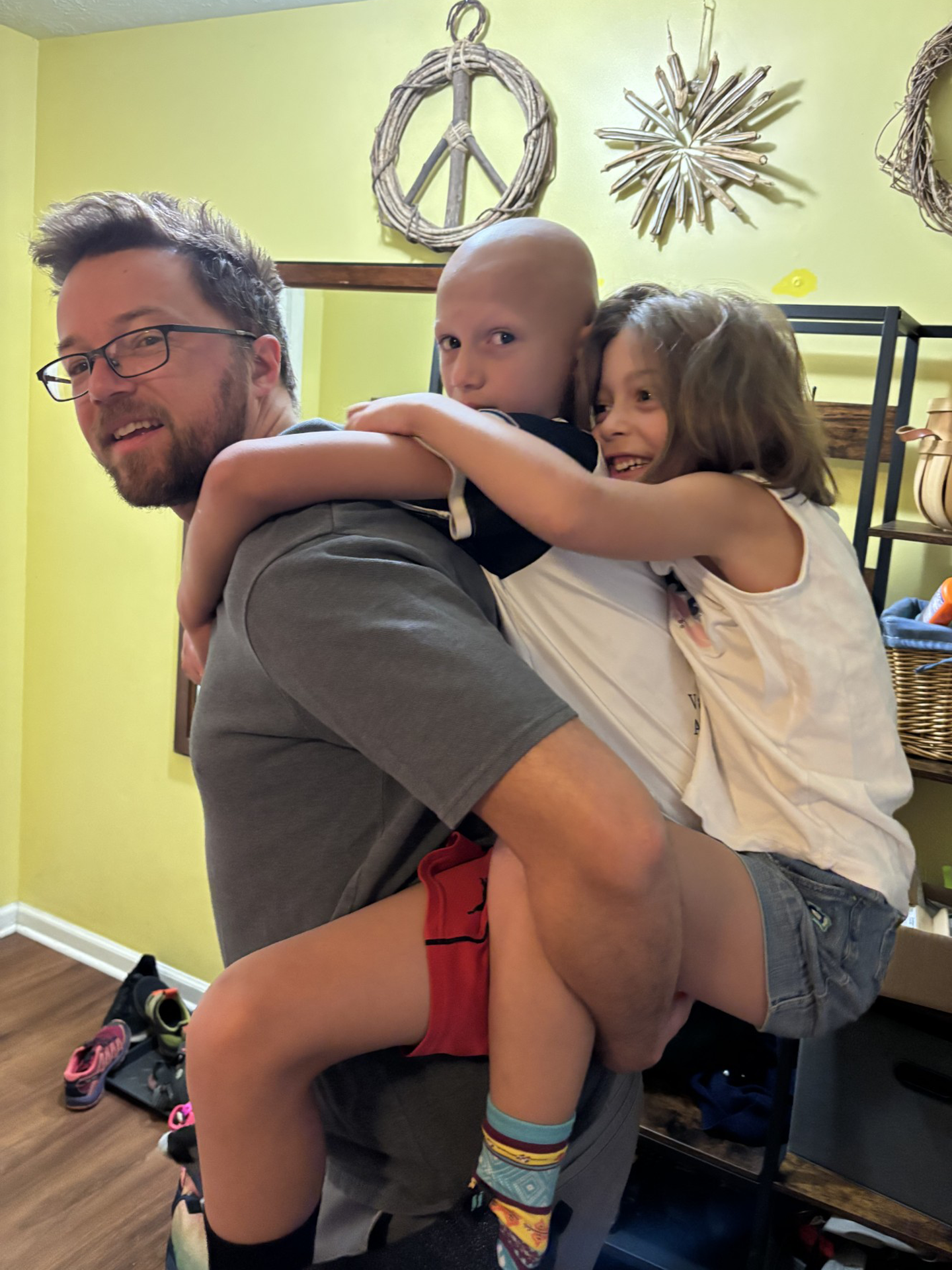
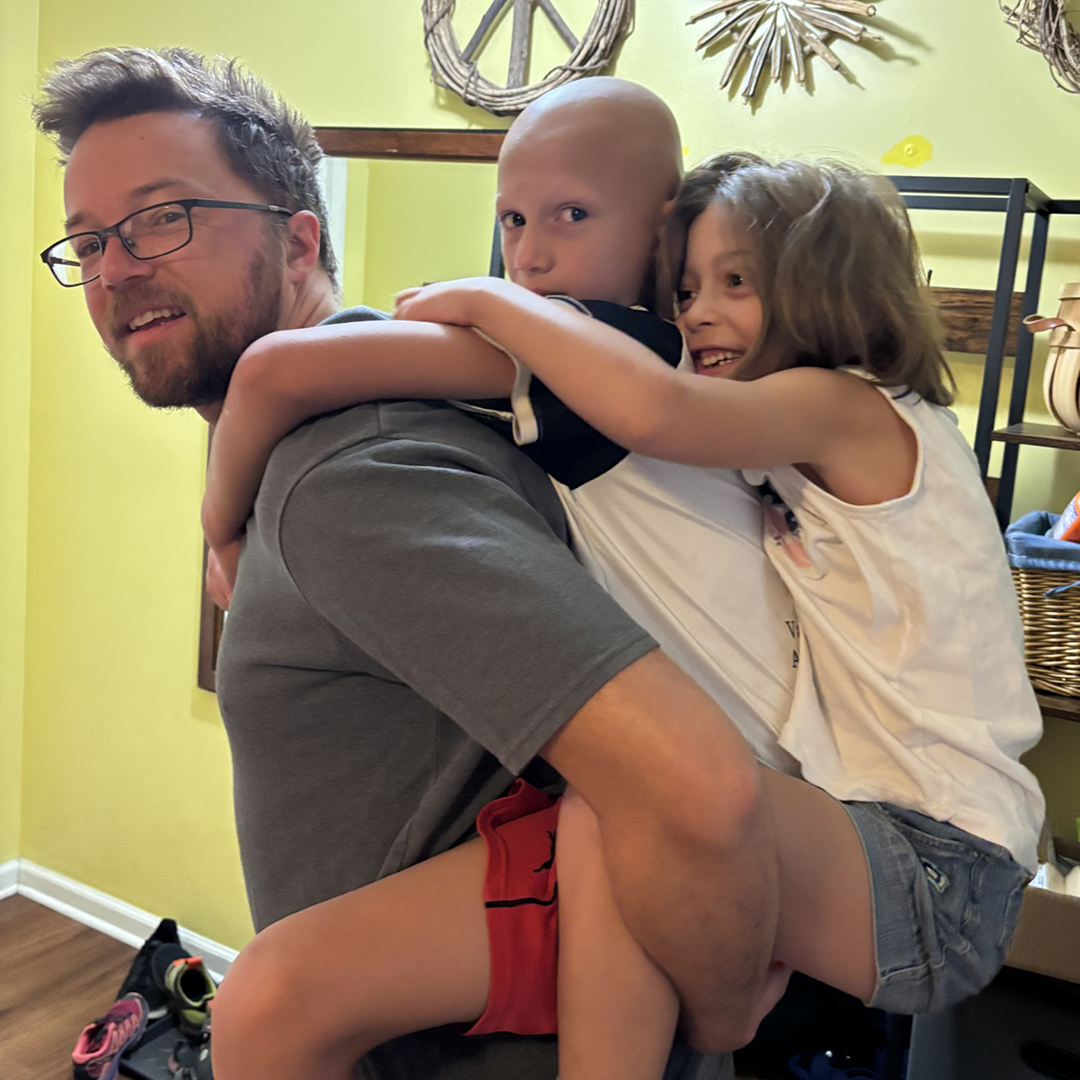
Left: Max enjoying his role of dad at home with his kids.
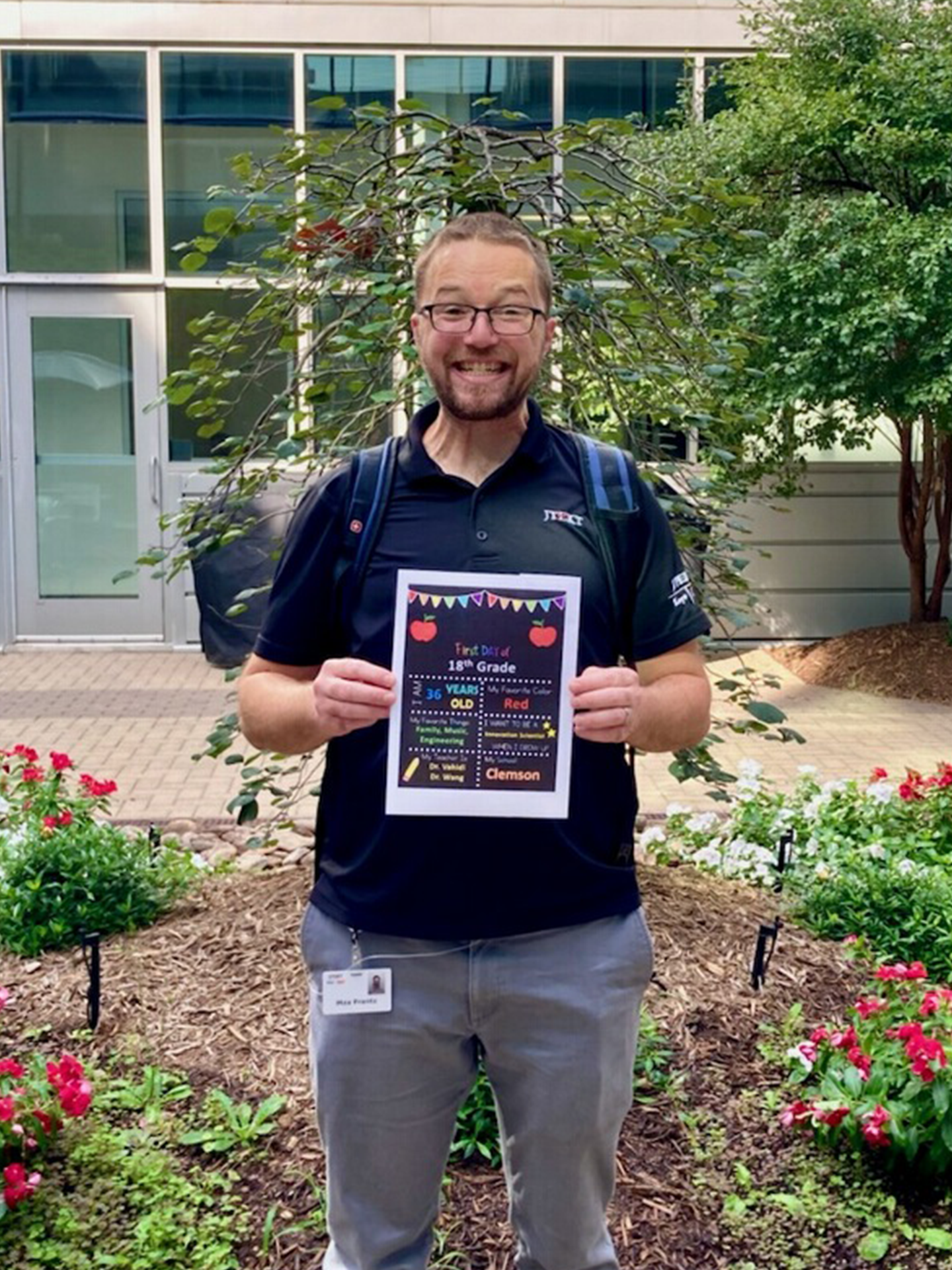
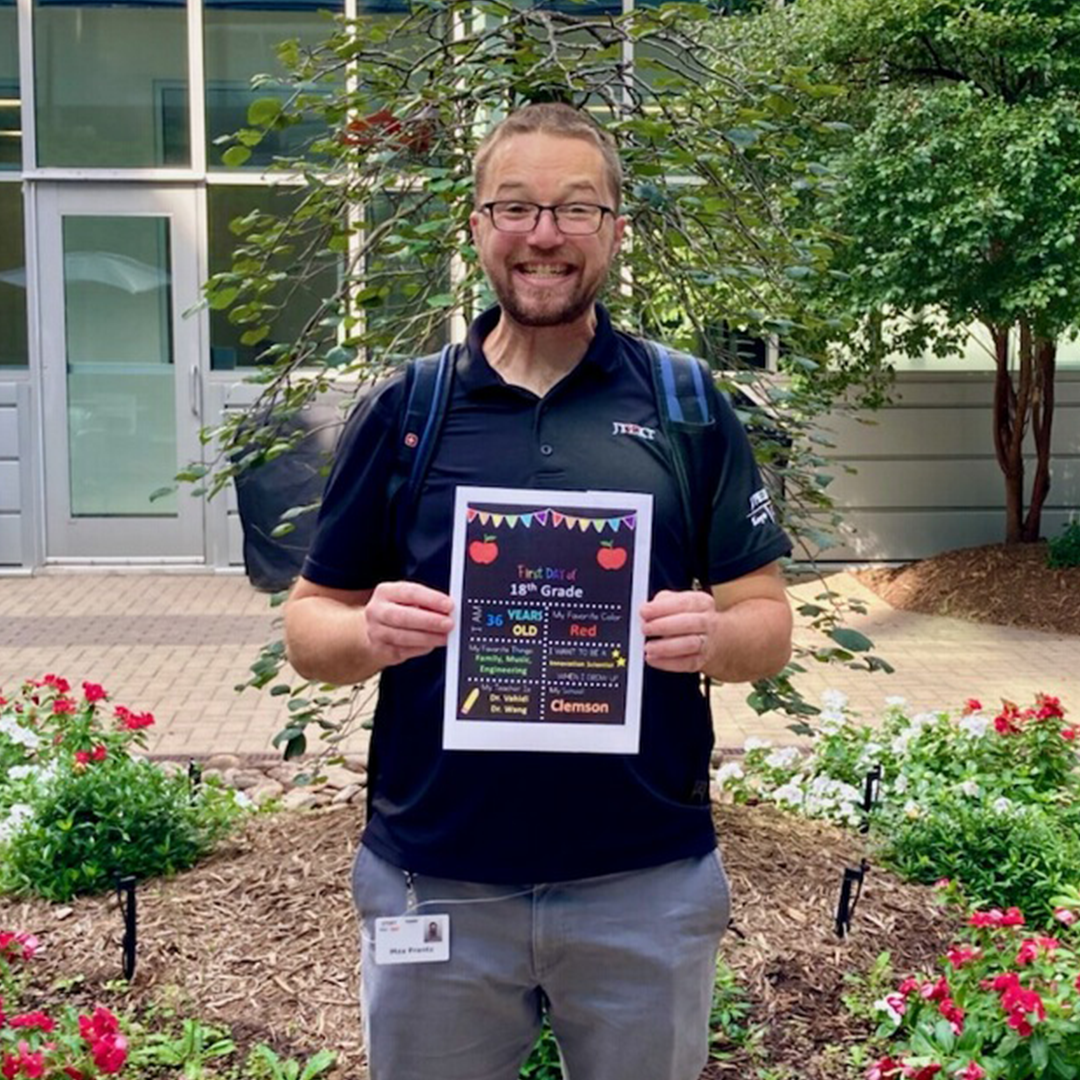
Right: Max takes part in the classic back to school tradition on his first day of his graduate coursework.
That proximity made a busy schedule more manageable—but it wasn’t the only benefit of the setting. Being based at CU-ICAR made balancing work, school, and family more manageable. The campus’s practical amenities—like nearby dining options, a fitness center, walking trails, and easy parking—helped Max stay focused, energized, and on schedule throughout his busy days.
Though the logistics were in his favor, the commitment was still demanding. Juggling a full-time role and parenting two young kids while completing graduate coursework wasn’t easy—but Max took it on with a focus geared toward growth.
“I didn’t really feel relief when I finished,” he reflected. “While I’m glad to have time to explore other things, I really enjoyed the process of continual learning.”
Since completing his degree, Max has continued to build on what he learned—both in his day-to-day work and through side projects that keep his skills sharp. He’s also taken time to share his perspective with Clemson mechanical engineering students who stop by his office looking for advice or insight into the field.
For Max, learning isn’t limited to the workplace or the classroom—it’s a mindset that carries into all aspects of his life. Whether he’s diving into new engineering challenges, taking on graduate studies, or exploring the outdoors with his family, Max thrives on discovering what’s next. That spirit of curiosity fuels his growth, keeps his work engaging, and helps him create meaningful experiences with the people who matter most.


What began as a personal decision to be closer to family has led Max Frantz to a career that continues to challenge and inspire him—while also allowing space for what matters most outside of work.
When Max and his wife made the decision to move from Philadelphia, their goal was simple: be closer to family and raise their children in a place with natural beauty and a strong sense of community. Greenville, South Carolina—tucked against the foothills of the Blue Ridge Mountains—offered just that.
Shortly after relocating, Max accepted a role as a Principal Product Development Engineer with JTEKT North America. The job proved to be a perfect fit. On the new product development team, Max works on the front end of innovation—identifying emerging needs and rapidly building proof-of-concept tests to determine what’s worth pursuing.
Eight years later, that work still excites him. Whether he’s brainstorming new solutions or rolling up his sleeves to build out an early prototype, Max continues to thrive in a role that keeps him engaged and thinking forward.
At home, he finds equal joy in his role as a dad. From family hikes at Paris Mountain State Park to weekends spent at kids’ sporting events, Max is all-in—professionally and personally.
Over time, Max began to feel a pull toward expanding his technical expertise. His interest in automated systems and advanced mechanical design kept growing, and he wanted to understand not just how things work—but why.
With encouragement and financial support from JTEKT, he enrolled in Clemson University’s Master’s program in Mechanical Engineering. The location made it even more feasible—many of his classes were held at the Carroll A. Campbell Graduate Education Center, located on the CU-ICAR campus, just steps from his office.
“It was incredibly convenient to take classes here at CU-ICAR in Greenville,” Max said. “I could be working in my office at JTEKT, simply walk across the street to class, and then return to the office.”


Left: Max enjoying his role of dad at home with his kids.
Right: Max takes part in the classic back to school tradition on his first day of his graduate coursework.
That proximity made a busy schedule more manageable—but it wasn’t the only benefit of the setting. Being based at CU-ICAR made balancing work, school, and family more manageable. The campus’s practical amenities—like nearby dining options, a fitness center, walking trails, and easy parking—helped Max stay focused, energized, and on schedule throughout his busy days.
Though the logistics were in his favor, the commitment was still demanding. Juggling a full-time role and parenting two young kids while completing graduate coursework wasn’t easy—but Max took it on with a focus geared toward growth.
“I didn’t really feel relief when I finished,” he reflected. “While I’m glad to have time to explore other things, I really enjoyed the process of continual learning.”
Since completing his degree, Max has continued to build on what he learned—both in his day-to-day work and through side projects that keep his skills sharp. He’s also taken time to share his perspective with Clemson mechanical engineering students who stop by his office looking for advice or insight into the field.
For Max, learning isn’t limited to the workplace or the classroom—it’s a mindset that carries into all aspects of his life. Whether he’s diving into new engineering challenges, taking on graduate studies, or exploring the outdoors with his family, Max thrives on discovering what’s next. That spirit of curiosity fuels his growth, keeps his work engaging, and helps him create meaningful experiences with the people who matter most.


What began as a personal decision to be closer to family has led Max Frantz to a career that continues to challenge and inspire him—while also allowing space for what matters most outside of work.
When Max and his wife made the decision to move from Philadelphia, their goal was simple: be closer to family and raise their children in a place with natural beauty and a strong sense of community. Greenville, South Carolina—tucked against the foothills of the Blue Ridge Mountains—offered just that.
Shortly after relocating, Max accepted a role as a Principal Product Development Engineer with JTEKT North America. The job proved to be a perfect fit. On the new product development team, Max works on the front end of innovation—identifying emerging needs and rapidly building proof-of-concept tests to determine what’s worth pursuing.
Eight years later, that work still excites him. Whether he’s brainstorming new solutions or rolling up his sleeves to build out an early prototype, Max continues to thrive in a role that keeps him engaged and thinking forward.
At home, he finds equal joy in his role as a dad. From family hikes at Paris Mountain State Park to weekends spent at kids’ sporting events, Max is all-in—professionally and personally.

Max enjoying his role of dad at home with his kids.
Over time, Max began to feel a pull toward expanding his technical expertise. His interest in automated systems and advanced mechanical design kept growing, and he wanted to understand not just how things work—but why.
With encouragement and financial support from JTEKT, he enrolled in Clemson University’s Master’s program in Mechanical Engineering. The location made it even more feasible—many of his classes were held at the Carroll A. Campbell Graduate Education Center, located on the CU-ICAR campus, just steps from his office.
“It was incredibly convenient to take classes here at CU-ICAR in Greenville,” Max said. “I could be working in my office at JTEKT, simply walk across the street to class, and then return to the office.”

Max takes part in the classic back to school tradition on his first day of his graduate coursework.
That proximity made a busy schedule more manageable—but it wasn’t the only benefit of the setting. Being based at CU-ICAR made balancing work, school, and family more manageable. The campus’s practical amenities—like nearby dining options, a fitness center, walking trails, and easy parking—helped Max stay focused, energized, and on schedule throughout his busy days.
Though the logistics were in his favor, the commitment was still demanding. Juggling a full-time role and parenting two young kids while completing graduate coursework wasn’t easy—but Max took it on with a focus geared toward growth.
“I didn’t really feel relief when I finished,” he reflected. “While I’m glad to have time to explore other things, I really enjoyed the process of continual learning.”
Since completing his degree, Max has continued to build on what he learned—both in his day-to-day work and through side projects that keep his skills sharp. He’s also taken time to share his perspective with Clemson mechanical engineering students who stop by his office looking for advice or insight into the field.
For Max, learning isn’t limited to the workplace or the classroom—it’s a mindset that carries into all aspects of his life. Whether he’s diving into new engineering challenges, taking on graduate studies, or exploring the outdoors with his family, Max thrives on discovering what’s next. That spirit of curiosity fuels his growth, keeps his work engaging, and helps him create meaningful experiences with the people who matter most.


This content is password-protected. To view it, please enter the password below.
]]>
VIPR-GS Highlights Impactful Internship Experience For Students
August 28, 2025
By VIPR-GS Intern Kate DeStefano
VIPR-GS Highlights Impactful Internship Experience For Students
August 28, 2025
By VIPR-GS Intern Kate DeStefano
The Virtual Prototyping of Autonomy-Enabled Ground Systems Research Center (VIPR-GS) and Clemson University are celebrating the achievements of its recent fall and spring semester Honors College interns who worked closely with faculty members on advanced research projects involving autonomy, robotics, coding, and engineering.
These internships have provided the students involved with a unique opportunity to gain real-world experience in an academic and research setting. Each project helps to prompt VIPR-GS’s ongoing mission: Create advanced tools for virtual prototyping and agile physical prototyping, driven by research breakthroughs in autonomous off-road vehicles and next-generation propulsion technologies. The initiative also focuses on intelligent fleet energy management, enabling more efficient, adaptable, and sustainable development and deployment of off-road vehicle systems.
The interns collaborated directly with professors on projects involving CAD programs, coding through Python, autonomy kits, creating models, learning sensor setups, and many more exciting and innovative skills.
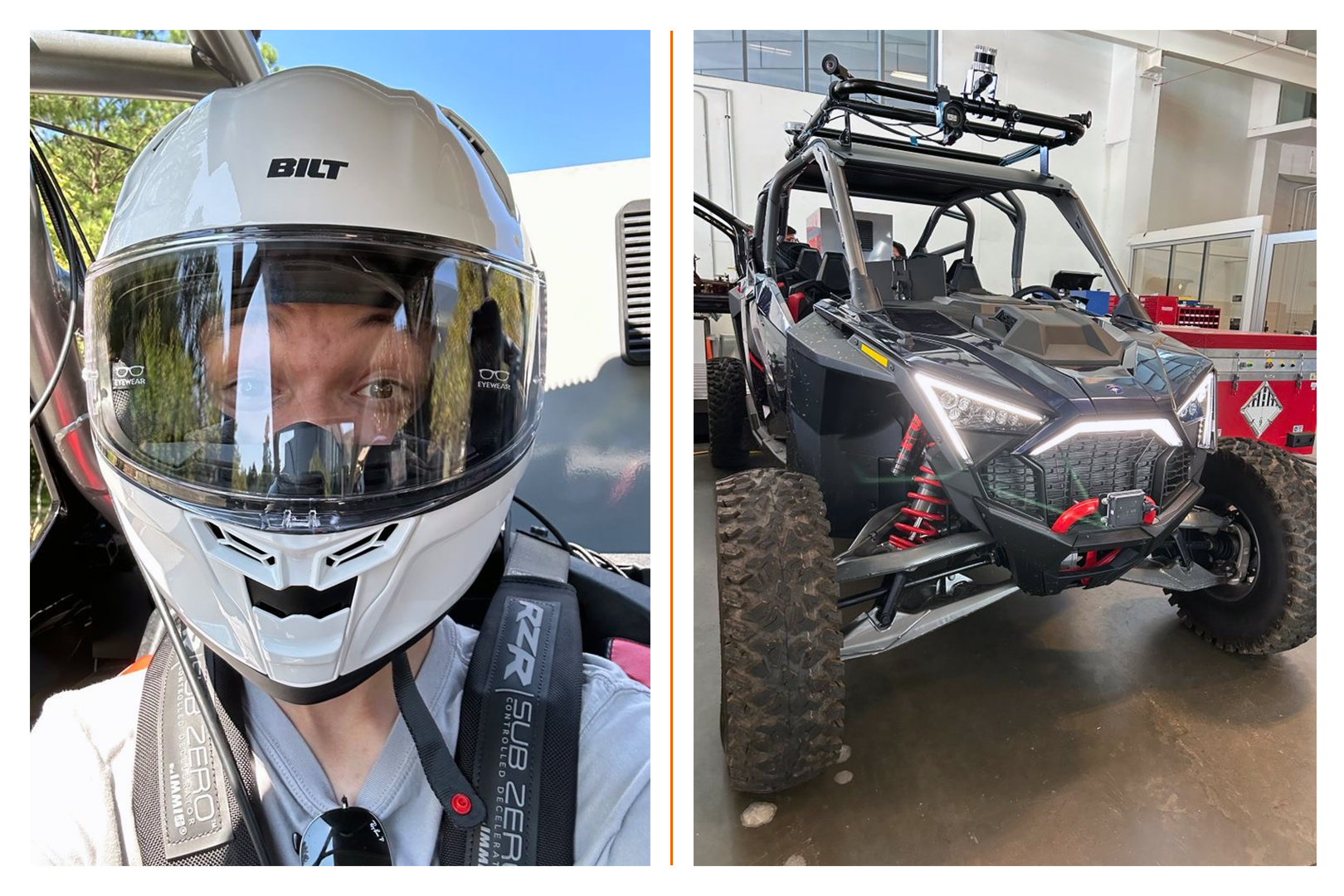
Jacob Davis, one of the interns that was chosen to work through this program, describes his time as “dynamic and fast-paced”. He said, “As a part of my VIPR internship, I joined Yunyi Jia’s CRA (Collaborative Robotics and Automation) Lab. Over the past semester I have worked on a project involving research for an autonomy kit solution for an industry partner.” Through many hours of research and testing Jacob, accompanied by graduate students in Jia’s lab, was able to “collect and set up a robust array of sensors on the autonomous RZR vehicle for testing autonomy algorithms.”

Jacob Davis validating research in a Polaris RZR equipped for autonomy.
This internship program was designed to prepare students for careers in research, engineering, modeling, simulations, and autonomy. By working side-by-side with Clemson University researchers, interns not only deepened their technical knowledge but also developed soft skills like communication, time-management, and problem-solving.
Katelynn Hughes, an intern who worked closely with Apparao Rao and Greg Mocko to develop her coding and modeling skills said that this opportunity has allowed her to “create a clearer idea of what career I wanted to pursue with my degree.” Internships like this are more than just resume builders, they provide hands-on experience, foster mentorship, and allow students to see firsthand how their academic learning applies in high-impact research environments. Among many things, Katelynn learned how to develop code using Python, Siemens NX, and creating assemblies in different CAD programs.
Throughout the school year, interns also got the opportunity to participate in lab meetings and progress presentations. These experiences specifically help to bridge the gap between classroom learning and practical application. Jeff Fine, Senior Associate Dean of the Clemson University Honors College, said “Internships are excellent opportunities for students to expand their networks and explore potential careers. Our top students and alumni often talk about how an internship experience helped them figure out what they want to do or in some cases what they don’t want to do. Both outcomes are invaluable for students to find their passion and their path.”

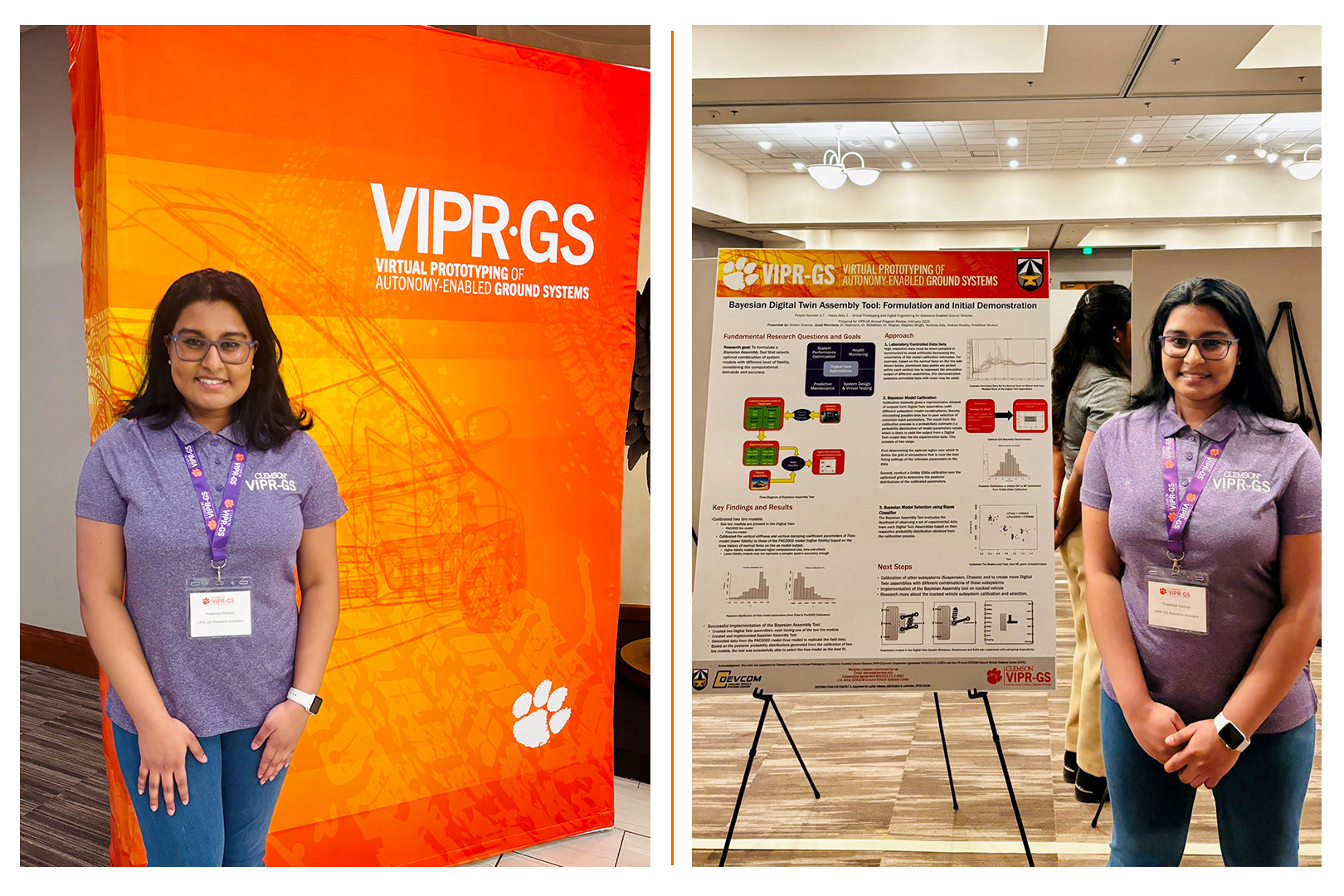
Preethika Yetukuri presented research findings at the VIPR-GS Research Center annual review.
According to The Princeton Review, Clemson University was ranked 11th nationally for “best public schools for internship opportunities.” This recognition highlights Clemson’s strong focus on experiential learning, career readiness, and its commitment to connecting students with real-world professional experiences that prepare them for life after graduation.
As the program looks ahead, VIPR-GS is committed to expanding internship opportunities and strengthening partnerships across disciplines and institutions to support future cohorts of student researchers.
Learn more about the VIPR-GS Research Center here.
Acknowledgment: This work was supported by Clemson University’s Virtual Prototyping of Autonomy Enabled Ground Systems (VIPR-GS), under Cooperative Agreement W56HZV-21-2-0001 with the US Army DEVCOM Ground Vehicle Systems Center (GVSC).

The Virtual Prototyping of Autonomy-Enabled Ground Systems Research Center Center (VIPR-GS) and Clemson University are celebrating the achievements of its recent fall and spring semester Honors College interns who worked closely with faculty members on advanced research projects involving autonomy, robotics, coding, and engineering.
These internships have provided the students involved with a unique opportunity to gain real-world experience in an academic and research setting. Each project helps to prompt VIPR-GS’s ongoing mission: Create advanced tools for virtual prototyping and agile physical prototyping, driven by research breakthroughs in autonomous off-road vehicles and next-generation propulsion technologies. The initiative also focuses on intelligent fleet energy management, enabling more efficient, adaptable, and sustainable development and deployment of off-road vehicle systems.
The interns collaborated directly with professors on projects involving CAD programs, coding through Python, autonomy kits, creating models, learning sensor setups, and many more exciting and innovative skills.
Jacob Davis, one of the interns that was chosen to work through this program, describes his time as “dynamic and fast-paced”. He said, “As a part of my VIPR internship, I joined Yunyi Jia’s CRA (Collaborative Robotics and Automation) Lab. Over the past semester I have worked on a project involving research for an autonomy kit solution for an industry partner.” Through many hours of research and testing Jacob, accompanied by graduate students in Jia’s lab, was able to “collect and set up a robust array of sensors on the autonomous RZR vehicle for testing autonomy algorithms.”

Jacob Davis validating research in a Polaris RZR equipped for autonomy.
This internship program was designed to prepare students for careers in research, engineering, modeling, simulations, and autonomy. By working side-by-side with Clemson University researchers, interns not only deepened their technical knowledge but also developed soft skills like communication, time-management, and problem-solving.
Katelynn Hughes, an intern who worked closely with Apparao Rao and Greg Mocko to develop her coding and modeling skills said that this opportunity has allowed her to “create a clearer idea of what career I wanted to pursue with my degree.” Internships like this are more than just resume builders, they provide hands-on experience, foster mentorship, and allow students to see firsthand how their academic learning applies in high-impact research environments. Among many things, Katelynn learned how to develop code using Python, Siemens NX, and creating assemblies in different CAD programs.
Throughout the school year, interns also got the opportunity to participate in lab meetings and progress presentations. These experiences specifically help to bridge the gap between classroom learning and practical application. Jeff Fine, Senior Associate Dean of the Clemson University Honors College, said “Internships are excellent opportunities for students to expand their networks and explore potential careers. Our top students and alumni often talk about how an internship experience helped them figure out what they want to do or in some cases what they don’t want to do. Both outcomes are invaluable for students to find their passion and their path.”

Preethika Yetukuri presented research findings at the VIPR-GS Research Center annual review.
According to The Princeton Review, Clemson University was ranked 11th nationally for “best public schools for internship opportunities.” This recognition highlights Clemson’s strong focus on experiential learning, career readiness, and its commitment to connecting students with real-world professional experiences that prepare them for life after graduation.
As the program looks ahead, VIPR-GS is committed to expanding internship opportunities and strengthening partnerships across disciplines and institutions to support future cohorts of student researchers.
Learn more about the VIPR-GS Research Center here.
Acknowledgment: This work was supported by Clemson University’s Virtual Prototyping of Autonomy Enabled Ground Systems (VIPR-GS), under Cooperative Agreement W56HZV-21-2-0001 with the US Army DEVCOM Ground Vehicle Systems Center (GVSC).

The Virtual Prototyping of Autonomy-Enabled Ground Systems Research Center (VIPR-GS) and Clemson University are celebrating the achievements of its recent fall and spring semester Honors College interns who worked closely with faculty members on advanced research projects involving autonomy, robotics, coding, and engineering.
These internships have provided the students involved with a unique opportunity to gain real-world experience in an academic and research setting. Each project helps to prompt VIPR-GS’s ongoing mission: Create advanced tools for virtual prototyping and agile physical prototyping, driven by research breakthroughs in autonomous off-road vehicles and next-generation propulsion technologies. The initiative also focuses on intelligent fleet energy management, enabling more efficient, adaptable, and sustainable development and deployment of off-road vehicle systems.
The interns collaborated directly with professors on projects involving CAD programs, coding through Python, autonomy kits, creating models, learning sensor setups, and many more exciting and innovative skills.
Jacob Davis, one of the interns that was chosen to work through this program, describes his time as “dynamic and fast-paced”. He said, “As a part of my VIPR internship, I joined Yunyi Jia’s CRA (Collaborative Robotics and Automation) Lab. Over the past semester I have worked on a project involving research for an autonomy kit solution for an industry partner.” Through many hours of research and testing Jacob, accompanied by graduate students in Jia’s lab, was able to “collect and set up a robust array of sensors on the autonomous RZR vehicle for testing autonomy algorithms.”

Jacob Davis validating research in a Polaris RZR equipped for autonomy.
This internship program was designed to prepare students for careers in research, engineering, modeling, simulations, and autonomy. By working side-by-side with Clemson University researchers, interns not only deepened their technical knowledge but also developed soft skills like communication, time-management, and problem-solving.
Katelynn Hughes, an intern who worked closely with Apparao Rao and Greg Mocko to develop her coding and modeling skills said that this opportunity has allowed her to “create a clearer idea of what career I wanted to pursue with my degree.” Internships like this are more than just resume builders, they provide hands-on experience, foster mentorship, and allow students to see firsthand how their academic learning applies in high-impact research environments. Among many things, Katelynn learned how to develop code using Python, Siemens NX, and creating assemblies in different CAD programs.
Throughout the school year, interns also got the opportunity to participate in lab meetings and progress presentations. These experiences specifically help to bridge the gap between classroom learning and practical application. Jeff Fine, Senior Associate Dean of the Clemson University Honors College, said “Internships are excellent opportunities for students to expand their networks and explore potential careers. Our top students and alumni often talk about how an internship experience helped them figure out what they want to do or in some cases what they don’t want to do. Both outcomes are invaluable for students to find their passion and their path.”

Preethika Yetukuri presented research findings at the VIPR-GS Research Center annual review.
According to The Princeton Review, Clemson University was ranked 11th nationally for “best public schools for internship opportunities.” This recognition highlights Clemson’s strong focus on experiential learning, career readiness, and its commitment to connecting students with real-world professional experiences that prepare them for life after graduation.
As the program looks ahead, VIPR-GS is committed to expanding internship opportunities and strengthening partnerships across disciplines and institutions to support future cohorts of student researchers.
Learn more about the VIPR-GS Research Center here.
Acknowledgment: This work was supported by Clemson University’s Virtual Prototyping of Autonomy Enabled Ground Systems (VIPR-GS), under Cooperative Agreement W56HZV-21-2-0001 with the US Army DEVCOM Ground Vehicle Systems Center (GVSC).

Gregory Mocko to lead Clemson University’s Deep Orange program
August 15, 2025
Gregory Mocko to lead Clemson University’s Deep Orange program
August 15, 2025
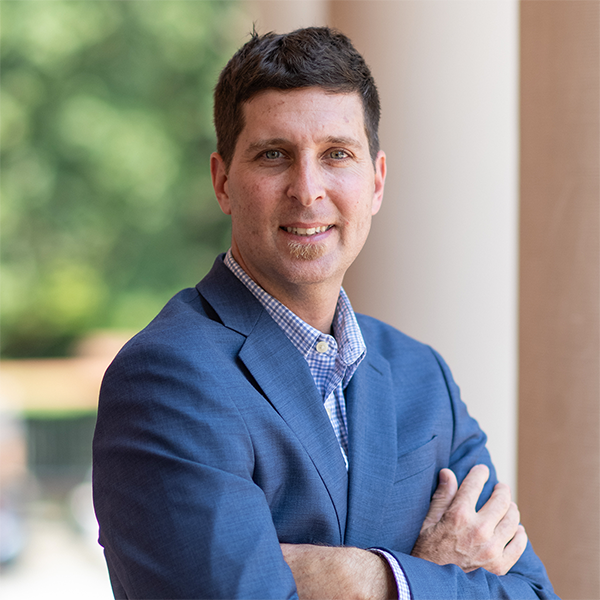
Gregory Mocko, associate professor of mechanical engineering and a champion of industry-driven education, has been named director of Clemson University’s acclaimed Deep Orange program, effective Aug. 15.
Mocko takes the wheel from Rob Prucka, who will turn more attention toward departmental leadership and the VIPR-GS program. Mocko’s appointment puts a seasoned educator, innovator and industry collaborator at the helm of one of the nation’s most distinctive automotive engineering initiatives.
Deep Orange is a prototype vehicle program that is part of the automotive engineering degree curriculum and based at the Clemson University International Center for Automotive Research (CU-ICAR).
Over two years, graduate students in automotive engineering work with faculty and major industry sponsors to design, build and debut a concept vehicle. BMW, Toyota, General Motors, Honda R&D Americas, Ford, Mazda, ExxonMobil, NVIDIA, and the U.S. Army are among the companies that have backed Deep Orange projects.
As Deep Orange director, Mocko will oversee the program’s strategic vision, guide students through each project’s lifecycle and strengthen faculty and industry partnerships.
Mocko, a Clemson faculty member since 2006, has built his career on connecting students with real-world engineering challenges. He formerly coordinated Clemson’s Mechanical Engineering Capstone Design Program and has overseen ambitious projects such as a nationwide student collaboration to design, build, and fly an unmanned aerial vehicle modeled on Boeing’s Dreamliner assembly approach.
Mocko’s research spans model-based systems engineering, AI in engineering design, and advanced manufacturing, and he has published more than 70 peer-reviewed articles.
Laine Mears, director of the School of Mechanical and Automotive Engineering, said that Mocko is ready to take on the current Deep Orange 17 program and begin defining future Deep Orange projects, noting that his nearly two decades of design research and practical application experience will serve Deep Orange well.
“Dr. Mocko brings a fresh perspective and a rich background in connecting students and industry, using innovative programs as the bridge,” Mears said. “He is highly regarded by his students and his colleagues. With him in the driver’s seat, Deep Orange is well positioned to go farther and faster!”

Gregory Mocko, associate professor of mechanical engineering and a champion of industry-driven education, has been named director of Clemson University’s acclaimed Deep Orange program, effective Aug. 15.
Mocko takes the wheel from Rob Prucka, who will turn more attention toward departmental leadership and the VIPR-GS program. Mocko’s appointment puts a seasoned educator, innovator and industry collaborator at the helm of one of the nation’s most distinctive automotive engineering initiatives.
Deep Orange is a prototype vehicle program that is part of the automotive engineering degree curriculum and based at the Clemson University International Center for Automotive Research (CU-ICAR).
Over two years, graduate students in automotive engineering work with faculty and major industry sponsors to design, build and debut a concept vehicle. BMW, Toyota, General Motors, Honda R&D Americas, Ford, Mazda, ExxonMobil, NVIDIA, and the U.S. Army are among the companies that have backed Deep Orange projects.
As Deep Orange director, Mocko will oversee the program’s strategic vision, guide students through each project’s lifecycle and strengthen faculty and industry partnerships.
Mocko, a Clemson faculty member since 2006, has built his career on connecting students with real-world engineering challenges. He formerly coordinated Clemson’s Mechanical Engineering Capstone Design Program and has overseen ambitious projects such as a nationwide student collaboration to design, build, and fly an unmanned aerial vehicle modeled on Boeing’s Dreamliner assembly approach.
Mocko’s research spans model-based systems engineering, AI in engineering design, and advanced manufacturing, and he has published more than 70 peer-reviewed articles.
Laine Mears, director of the School of Mechanical and Automotive Engineering, said that Mocko is ready to take on the current Deep Orange 17 program and begin defining future Deep Orange projects, noting that his nearly two decades of design research and practical application experience will serve Deep Orange well.
“Dr. Mocko brings a fresh perspective and a rich background in connecting students and industry, using innovative programs as the bridge,” Mears said. “He is highly regarded by his students and his colleagues. With him in the driver’s seat, Deep Orange is well positioned to go farther and faster!”

Gregory Mocko, associate professor of mechanical engineering and a champion of industry-driven education, has been named director of Clemson University’s acclaimed Deep Orange program, effective Aug. 15.
Mocko takes the wheel from Rob Prucka, who will turn more attention toward departmental leadership and the VIPR-GS program. Mocko’s appointment puts a seasoned educator, innovator and industry collaborator at the helm of one of the nation’s most distinctive automotive engineering initiatives.
Deep Orange is a prototype vehicle program that is part of the automotive engineering degree curriculum and based at the Clemson University International Center for Automotive Research (CU-ICAR).
Over two years, graduate students in automotive engineering work with faculty and major industry sponsors to design, build and debut a concept vehicle. BMW, Toyota, General Motors, Honda R&D Americas, Ford, Mazda, ExxonMobil, NVIDIA, and the U.S. Army are among the companies that have backed Deep Orange projects.
As Deep Orange director, Mocko will oversee the program’s strategic vision, guide students through each project’s lifecycle and strengthen faculty and industry partnerships.
Mocko, a Clemson faculty member since 2006, has built his career on connecting students with real-world engineering challenges. He formerly coordinated Clemson’s Mechanical Engineering Capstone Design Program and has overseen ambitious projects such as a nationwide student collaboration to design, build, and fly an unmanned aerial vehicle modeled on Boeing’s Dreamliner assembly approach.
Mocko’s research spans model-based systems engineering, AI in engineering design, and advanced manufacturing, and he has published more than 70 peer-reviewed articles.
Laine Mears, director of the School of Mechanical and Automotive Engineering, said that Mocko is ready to take on the current Deep Orange 17 program and begin defining future Deep Orange projects, noting that his nearly two decades of design research and practical application experience will serve Deep Orange well.
“Dr. Mocko brings a fresh perspective and a rich background in connecting students and industry, using innovative programs as the bridge,” Mears said. “He is highly regarded by his students and his colleagues. With him in the driver’s seat, Deep Orange is well positioned to go farther and faster!”